
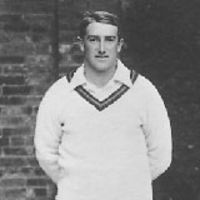
Aubrey Faulkner
South Africa
INTL CAREER: 1906 - 1924
Full Name
George Aubrey Faulkner
Born
December 17, 1881, Port Elizabeth, Cape Province
Died
September 10, 1930, Walham Green, Fulham, London, England, (aged 48y 267d)
Batting Style
Right hand Bat
Bowling Style
Legbreak Googly
Other
Coach

One of the greatest allrounders and arguably - despite an unorthodox and extraordinary grip of the bat - the best of coaches. His pupils included Ian Peebles and ET KIllick. He made a double-hundred against Australia at Melbourne in 1910-11; but was this a finer feat than his 6 for 17 in the third Test ever played at Leeds? Some would say, rather, that he accomplished nothing better than his 153 followed by 6 for 64 against the Australians at the Saffrons, Eastbourne in 1921. Afflicted by melancholia, he died tragically by his own hand.
EW Swanton
Wisden obituary
Major Aubrey Faulkner died of gas poisoning at the Faulkner School of Cricket, Ltd., on September 10, at the age of 48. During the South African War and whilst living in Cape Town, he received some coaching from Walter Richards, of Warwickshire, then engaged by Western Province, and later became not only one of the dominating figures in South African cricket but also one of the finest of allround players. One of the earliest exponents of the googly, he differed from other bowlers of that type because of his ability to send down quite a fast ball, almost a yorker, and when at his best, with faultless length, skill in turning the ball either way and a puzzling variation of flight he proved too much for some of the world's greatest batsmen.
Many will remember his fine bowling at Leeds in 1907 when, playing for South Africa in the second Test match of that series against England, he dismissed six men in the course of eleven overs for 17 runs. His career was full of remarkable performances. In that same season of 1907 he, in all matches for the South Africans, scored 1,288 runs and took seventy-three wickets. He was probably at his best in 1909-10 when his doings with both bat and ball against the English team were magnificent. When South Africa visited Australia in the season of 1910-11, Faulkner headed the Test match batting averages with 732 runs and an average of 73.20. In all matches during that tour he scored 2,080 runs, taking sixty wickets, and in the Test match at Melbourne he hit a splendid 204. For the team of 1912 he made 1,075 runs and obtained 163 wickets. Although at the beginning of his career, particularly at the time when he first became prominent in South African Inter-State cricket in 1906, he was of little value as a batsman, he became as the years passed, almost as great a batsman as he was a bowler. His style rather conveyed the impression of awkwardness and he could not, at any time, be described as a free, forcible bat. Nevertheless, very few men made runs with more assurance than Faulkner, and he was a most difficult batsman to get out. After settling down in England he had a great season in club cricket in Nottinghamshire, making twelve hundreds in scoring 2,868 runs with an average of 84.35, besides taking 218 wickets, including all ten in an innings on two occasions. Still, his finest innings in this country was at Eastbourne in 1921 when by a wonderful 153 against the Australians -- up to that point an unbeaten side -- he virtually gave victory to A. C. MacLaren's XI. Faulkner was also a first-rate field.
When the time came for him to retire from the game, he gained much distinction as acoach. He followed a theory entirely his own when he established the first cricket school known in London and at the time of his death the school had earned world-wide fame. Faulkner devoted the greater part of his time to the school, though he found opportunity to write many articles on the game. During the European War he served with distinction with the R.F.A. in Salonika, Egypt and Palestine, gaining the D.S.O. in 1918 and the Order of the Nile.
Wisden Cricketers' Almanack
Terms of Use|Privacy Policy|Your US State Privacy Rights|Children's Online Privacy Policy|Interest - Based Ads|Do Not Sell or Share My Personal Information|Feedback
© 2024 ESPN Sports Media Ltd. All rights reserved