
George Gunn
England
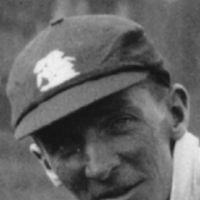
INTL CAREER: 1907 - 1930
Full Name
George Gunn
Born
June 13, 1879, Hucknall Torkard, Nottinghamshire
Died
June 29, 1958, Tylers Green, Cuckfield, Sussex, (aged 79y 16d)
Batting Style
Right hand Bat
Bowling Style
Right arm Bowler
RELATIONS
(son)

Wisden obituary
George Gunn, who died in his sleep at Tylers Green, Sussex, on June 28, aged 79, was probably the greatest batsman who played for Nottinghamshire. Had he possessed a different temperament he would doubtless have improved upon his splendid records, for his skill and judgement were such that he made batting successfully against first-class bowlers appear the easiest thing imaginable. Not only did he show complete mastery in the art of back-play, but he frequently got right in front of his wicket and walked down the pitch to meet the ball no matter what type of bowler he was facing. Rarely when he left his ground in this way did his skill betray him and yet, though obviously so completely at home that he could have done almost anything with the ball, he would make a stroke which sent it tamely to the bowler, to mid-off or to mid-on. In match after match this practice of merely killing the ball was indulged in to such an extent as to become almost an obsession. It appeared to furnish Gunn with complete satisfaction, but it occasioned considerable annoyance to spectators who knew that, if he wished, he could score both without undue effort and as rapidly as anybody.
A younger brother of John Gunn and a nephew of William Gunn, George Gunn first appeared for Nottinghamshire in 1902. He met with no special success to begin with, but displayed such good style and powers of defence that there could be little doubt about his class. He steadily improved, but a haemorrhage of the lungs late in July ended his cricket for the summer. Happily a winter in New Zealand did him so much good that in 1907 he took the field again and, finishing at the top of the averages, bore a big part in winning the Championship for Nottinghamshire. Although his health was thus obviously re-established, his friends decided that he should spend the next winter in Australia. There went a team sent by M.C.C. and the illness of A. O. Jones, the captain, necessitated a call upon Gunn's services. The young professional made full use of his chance, making 119 and 74 in the first of the five Test matches, 122 not out in the fifth and for the whole tour heading the batting figures with an average of 5l.
Visiting Australia again in 1911-12 under J. W. H. T. Douglas, Gunn again showed to marked advantage, batting so consistently that he averaged 42 in the Test matches. While he enjoyed a well-earned reputation for Test cricket in Australia, he had a tragic experience in England, where only once, at Lord's in 1909, was he called upon to play for his country. Upon his form at the time, his selection was a mistake; he himself thought he should not have been chosen and, playing without his usual confidence, he was dismissed for 1 and 0.
Apart from that failure upon what might have been a big occasion in his life, Gunn enjoyed a wonderfully successful career. For Nottinghamshire before the First World War he made over 13,000 runs in the course of twelve full seasons, his best summer being that of 1913 when he hit 1,697, average nearly 50. On cricket being resumed, he made five separate centuries in 1919, gaining an average of 65. For twelve consecutive seasons he registered over 1,000 runs, his aggregate amounting to nearly 1,800 in 1927 and again in 1928. Among his triumphs was a first-wicket stand of 252 with W. W. Whysall against Kent at Trent Bridge in 1924. He and Whysall altogether associated in 40 three-figure opening partnerships. Three times Gunn put together two hundreds in a match at Nottingham: 132 and 109 not out v. Yorkshire in 1913; 169 and 185 not out v. Surrey in 1919; and 100 and 110 v. Warwickshire in 1927 when aged 48. Characteristic of the man was the game with Yorkshire. He batted six hours for the 132, but, with no occasion for anxiety, he followed with 109 out of 129 in less than ninety minutes. He celebrated his 50th birthday by hitting 164 not out against Worcestershire at Worcester and in the West Indies next winter he and A. Sandham obtained 322 for the first wicket against Jamaica at Kingston.
In the course of his career, Gunn played 62 three-figure innings and registered 35,190 runs, average 35.90. Of these runs 1,577 came in Australia, where he averaged 52. He was an excellent field at slip, where he brought off most of his 438 catches. He shared in one rare, if not unique, performance in 1931 against Warwickshire at Edgbaston when he and his son, the late G. V. Gunn, each scored a century in the same innings.
Wisden Cricketers' Almanack
Terms of Use|Privacy Policy|Your US State Privacy Rights|Children's Online Privacy Policy|Interest - Based Ads|Do Not Sell or Share My Personal Information|Feedback
© 2024 ESPN Sports Media Ltd. All rights reserved